
14 April 2026
EUG2026 Salerno: Sport has the power to change the world
Nelson Mandela once declared:
“Sport has the power to change the world. It has the power to inspire, it has the power to unite people in a way that little else does. It speaks to youth in a language they understand. Sport can create hope, where once there was only despair. It is more powerful than governments in breaking down racial barriers. It laughs in the face of all types of discrimination.”
It was the year 2000, specifically during the Laureus World Sports Awards.
It is no coincidence that we have decided to open this article by reflecting on those words today.
In just a few months, from 18th July to 1st August, the University of Salerno and the surrounding region will welcome approximately 4,000 participants. These student-athletes and staff members, representing nearly 40 European countries and coming from around 400 universities, will gather for the eighth edition of the EUSA Games.
These 4,000 individuals, joined by those attending the events, the staff working behind the scenes, and those watching the matches online, will form a wave capable of showcasing the beauty of various disciplines through themes such as fair play, ethics, inclusion, equality, and the right to sport.
The EUSA Games (European University Sports Association), which move through different European cities and universities, also serve to tell a story of change and the values brought to the field by young students and their communities. We simply must begin with the concept of Fair Play.
Sport as a “Gymnasium for Morality”
The concept of Fair Play is more than mere adherence to the rules; it is a sporting ethic that prioritises respect and integrity over winning at all costs.
Its fascinating evolution stems from the roots of 19th-century Victorian England, within historic Public Schools such as Rugby and Eton. In these classrooms and on those pitches, sport was not just physical exercise but a pedagogical tool to shape the character of the future ruling class. The “gentleman” had to know how to win with humility and lose with dignity, protecting the purity of competition from the corruption of profit and extreme professionalism.
A key figure in this revolution was Thomas Arnold, the headmaster of Rugby School, who formalised the idea of team games as a lesson in self-discipline and cooperation. For Arnold, the playing field was a true “gymnasium for morality”. This vision was later universalised by Baron Pierre de Coubertin. By founding the modern Olympics, he transformed Fair Play into a global pillar. His famous spirit of “taking part” was not an invitation to give up, but to compete with honour, giving one’s best while respecting common rules.
The Pillars of Fair Play Today
Today, Fair Play is codified by international bodies (such as the CIFP – International Fair Play Committee) and rests on five fundamental elements.
Respect for the Rules
Honouring the sportsmanship without looking for shortcuts. This isn’t just about avoiding doping or simulation; it’s about rejecting any trick that might alter the result, knowing that a victory obtained through deception has no moral value.
Respect for the Opponent
The other person is not an enemy to be destroyed, but a necessary partner. Without an opponent giving their best, our own performance would have no meaning. Respect means recognising the value of others and never humiliating those you face.
Respect for the Referee
Accepting decisions with composure, even when they appear wrong. The ability not to yield to aggressive protests recognises human infallibility and preserves the order of the competition, turning frustration into discipline.
Equality of Opportunity
The principle of a level playing field. Ensuring that every athlete can compete under the same technical and environmental conditions is the only way to make merit the sole judge on the pitch.
Dignity
Consistency in behaviour. It means maintaining control and elegance in both triumph and defeat, avoiding arrogance and accepting defeat without making excuses.
When Sport Changed the World: 4 Iconic Moments
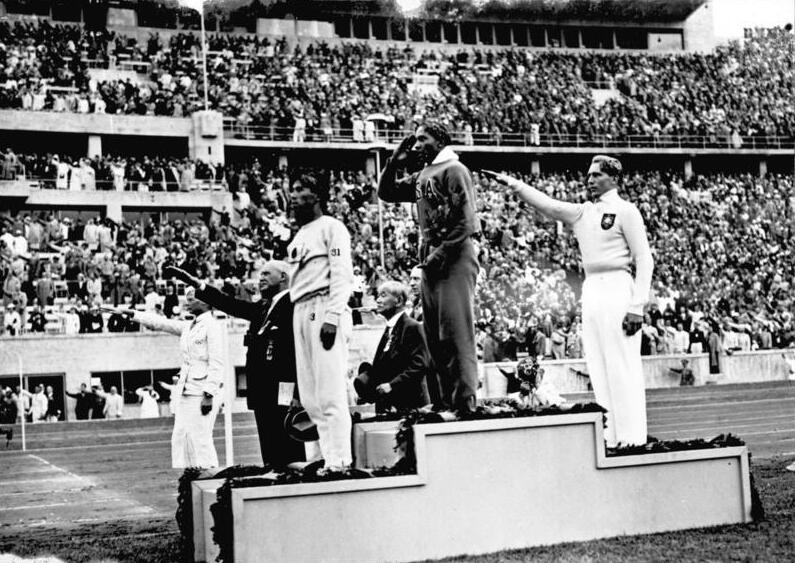
By Bundesarchiv, Bild 183-G00630 / Unknown author / CC-BY-SA 3.0, CC BY-SA 3.0 de, https://commons.wikimedia.org/w/index.php?curid=5363158
One of the most famous examples of Fair Play occurred at the 1936 Olympics, when German athlete Luz Long helped his African-American rival Jesse Owens correct his long jump technique to avoid elimination. Owens won gold and Long won silver, but a friendship was born that defied the era’s ideologies of hate.
Here are other historic moments every student-athlete should know.
Eugenio Monti and the Bolt (Innsbruck 1964)
Eugenio Monti was an Italian bobsledder, alpine skier, and racing driver. He is one of the most decorated athletes in bobsleigh history. During the two-man bobsleigh final, the legendary Italian athlete learned that his direct rivals, the British pair Nash and Dixon, had broken a vital bolt on their sledge. Without hesitation, Monti unscrewed a part from his own bobsleigh and gave it to his opponents. The British team repaired the fault and went on to win gold, while Monti finished third.
One of the most famous examples of Fair Play occurred at the 1936 Olympics, when German athlete Luz Long helped his African-American rival Jesse Owens correct his long jump technique to avoid elimination. Owens won gold and Long won silver, but a friendship was born that defied the era’s ideologies of hate.
Here are other historic moments every student-athlete should know.
Eugenio Monti and the Bolt (Innsbruck 1964)
Eugenio Monti was an Italian bobsledder, alpine skier, and racing driver. He is one of the most decorated athletes in bobsleigh history. During the two-man bobsleigh final, the legendary Italian athlete learned that his direct rivals, the British pair Nash and Dixon, had broken a vital bolt on their sledge. Without hesitation, Monti unscrewed a part from his own bobsleigh and gave it to his opponents. The British team repaired the fault and went on to win gold, while Monti finished third.
“Nash didn’t win because I gave him the bolt. He won because he drove faster.” Monti was the first athlete to receive the Pierre de Coubertin medal for Fair Play.
Judy Guinness and Honesty in Fencing (Los Angeles, 1932)
British fencer Judy Guinness was one step away from the Olympic gold medal. The judges had already awarded her the victory against the Austrian Ellen Preis, but it was Guinness herself who halted the celebrations. She informed the officials that they had failed to count two hits she had received; hits that only she had felt. Thanks to her honesty, the score was corrected, and the gold went to Preis. Judy chose the truth over the top step of the podium.
Abbey D’Agostino and Nikki Hamblin (Rio 2016)
During the 5,000 metres, American D’Agostino and New Zealander Hamblin collided and fell heavily. Instead of despairing over the compromised race, D’Agostino helped her rival get back up. Shortly after, the American faltered due to a ruptured cruciate ligament: at that point, it was Hamblin who stopped to support her. Both crossed the finish line last, arm in arm, proving that the human bond counts for more than the stopwatch.
Sources: CIFP (International Fair Play Committee); International Olympic Committee (IOC); Laureus.com; UNESCO (Sport and Anti-Discrimination).
Last News
News 4 August 2026
EUG 2026: impressive figures for the event that placed Salerno at the heart of Europe for 15 days
It is time to take stock of EUG Salerno 2026, the eighth edition of the European Universities Games, organised – for the first time ever in Italy – through the outstanding joint efforts of the University of Salerno, CUS Salerno and ADISURC, with the support of FederCUSI and the Campania Region.
News 3 August 2026
“Ciao Italia”: the baton passes to Split
The first historic Italian edition of the European Universities Games has come to an end.
News 3 August 2026
Medal haul on the final day of EUG Salerno 2026
On the final day of EUG Salerno 2026, European university titles were awarded in beach volleyball, tennis, football, badminton, 3×3 basketball, and handball.
News 31 July 2026
The games conclude tomorrow with the closing ceremony in Piazza Del Sapere
Tomorrow, August 1, will mark the final day of competition at EUG Salerno 2026.